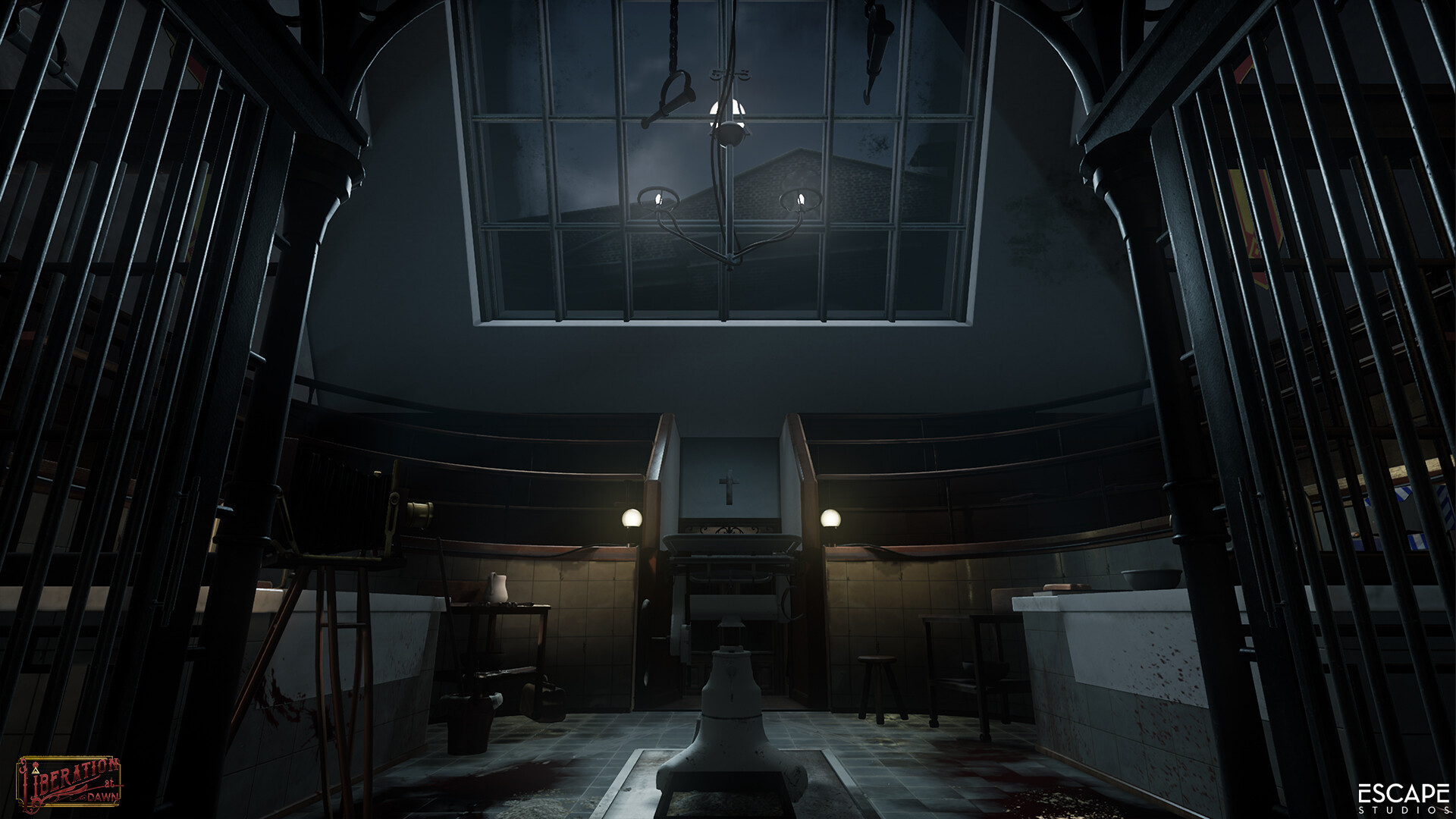
The more I think about this project the more I am definitely cemented in the idea of creating a horror themed game for mobile. This got me thinking what exactly makes a horror game truly scary?
I read a few articles about game mechanics in successful horror games but this particular article by Rockpapershotgun.com - How to make a scary game really scary was the most eye opening. Some of the key points are as follows:
***
1. Unpredictability: Letting the players imaginations fill in the blanks, eg that coat rack looks a lot like a person at first glance or in certain lighting.
''giving players enough information to form concrete worries but leaving them enough room to colour in the edges.... Grip says. “It’s like a job interview. It’s much worse before than during, because we’re experts at thinking of all the ways it could go wrong. So the anticipatory fright is way worse because of the uncertainty built into it.”
Continuing on for unpredictability was a very eye opening quote:
''Adding ambiguous shapes, or adding or removing objects from a scene that a player is familiar with, can also play tricks with the mind. When I think back to the playable teaser (P.T.) ''
''No Code’s McKellan worked on the UI for Alien: Isolation while at Creative Assembly, and purposefully made the objects you interacted with feel “glitchy”, so that players were always worried about it switching off.''
This has given me an idea to perhaps use a torch or phone battery as a game mechanic where the battery is slowly diminishing the more you use it. Forcing the player to choose between almost darkness and seeing the scene around them, they must get to a ''safe place'' to recharge their phone again. Perhaps have charging points throughout the level that may not always work.
***
2. Lighting: The article also suggest that it's not necessarily a lack of light that makes a scene scary but the way light plays across a variety of different surfaces with a small spattering of dark spaces.
Using a low dynamic range of lighting (brights that aren’t that bright, darks aren’t that dark) along with low colour saturation can also help give a “muted, decayed feeling” to a scene, he adds.''
***
3. Sound Design: Although within this project I am not sure how far I will be able to get into the sound design aspect of the game play, simple uses of knocks could be effective. I could give the impression of a monster somewhere in a part of the house that the player has to lead away from their objective. The monster being a ''hidden obstacle'' perhaps using knocks, bumps and growls could indicate where the monster has been located and it's up to the player to make noises in other parts of the house to make their path to the objective clear.
''Background noise is important, too. Grip aimed for “long, low tones throughout” in Amnesia, which make players feel immediately uneasy. “Low rumbles kick off something internal,” he says. And McKellan argues that Stories Untold’s often repetitive background noises, like heartbeats or computer bleeps, helped build tension.''
Perhaps using the vibrations of the mobile phone as ''notifications from mum'' could interrupt the mood and ease tension. Associating a particular noise with the approach or appearance of a monster or threat could be played and even if the monster is not seen it will still have the same affect on the player. They know they are near!
***
4. Pacing: The articles suggest that a ''Languid'' pace is ideal for horror games as it gives time for reflection on what has been happening throughout game play.
“Horror comes from slowly dawning realizations, and you need space for that,” '
“Instead of doing a typical game style, ‘three things and then something big happens’, we’re dealing out micro-reveals really slowly,” says McKellan. “And with each one you get a bit more information but not the full picture, and each one takes it in a different direction.” When I played it I felt really uneasy, and McKellan likens it to tightening a guitar string. “It’s getting higher and higher and you’re worried it’s going to snap, but you have to keep going.”
Grip says you can’t have “too many scares in one area”, because each one will be less impactful.
“The release of making it [to a save station] and breathing a sigh of relief was fantastic, and you wouldn’t have that feeling if you didn’t have the build up. It’s small victories, so people thought they could make it.”
***
5. Story and Character Development: From other articles and comments I read the other two elements that people felt strongly about was having some sort of mystery to solve (which is a personal favorite thing for me to do in games). Not only does this give more depth to the game itself but gives something for the player to think about and unravel on top of the actual game play puzzle solving. What has happened here? Why is this character behaving this way? etc. This can be further pushed by an ''Unreliable Protagonist'' a character that you play and become to identify and invest in is actually hiding something from themselves that they must eventually face in game. Although this is not something I'll probably have time to explore in this project it's something I should have in the back of my mind.
***
With these factors in mind I'm starting to get a clearer picture of what I want to try and achieve within this game project. I am still steadfast in creating a game from a child/teenager perspective with a tool such as a mobile phone as their only source of guiding light. Combined with the unnatural lighting from moonlight or twilight outside tall imposing windows and the odd candles. Locked doors need to have keys that need to be found but also an unseen danger that needs to be avoided and misdirected to make sure the final door can be open safely. How I will achieve this game puzzle I will need to see what is within my capabilities within the time frame but also will need to be plotted down on paper.
Perhaps a dying battery will be used as a time element within the ''mobile'' quick pick up and put down element. The aim to reach the next ''safe zone'' to reflect on what you have uncovered in the previous zone whilst your phone charges in a wall socket. A safe zone can be unlocked by the door you're trying to get to showing light shine under the door when its available to enter after completing a puzzle.
These are all ideas for now that I am just thinking about and putting down on paper. How much I will be able to achieve within this time frame is up for debate so I know I will have to focus on only one or two zones and the basics of mechanics.
Next, on top of my art bible, I will have to compile some guides to achieve character and object interactions I can achieve in unreal.